Crimes of the Educators by Samuel Blumenfeld
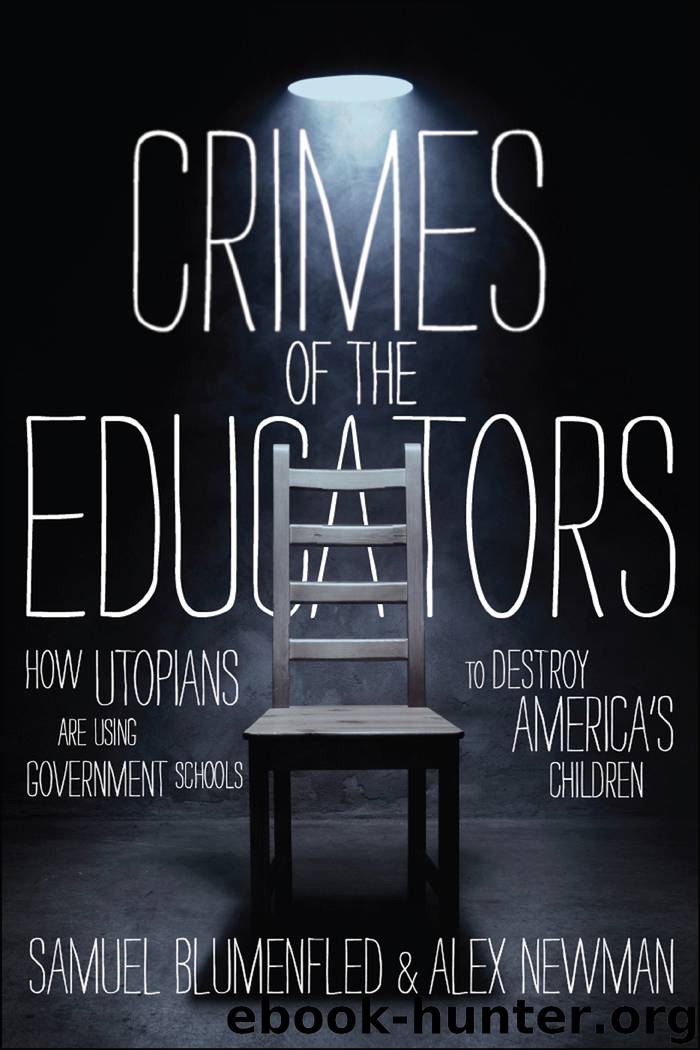
Author:Samuel Blumenfeld
Language: eng
Format: epub
Publisher: WND Books
Published: 2015-03-11T04:00:00+00:00
22
THE ROLE OF BEHAVIORAL PSYCHOLOGY IN THE DEWEY PLAN
It is the business of behavioristic psychology to be able to predict and control human activity.
– JOHN B. WATSON, FROM THE WAYS OF BEHAVIORISM, 1928
Another key tool used by the radical utopians in their war on education is known as “behavioral psychology.” The name sounds innocent enough. As we shall see, however, hidden behind this scheme is a scientific effort to literally mold an individual into the type of person desired by the education establishment.
In John Dewey’s 1898 plan to dumb down America, he wrote, “Change must come gradually. To force it unduly would compromise its final success by favoring a violent reaction. What is needed in the first place is that there should be a full and frank statement of conviction with regard to the matter from physiologists and psychologists and from those school administrators who are conscious of the evils of the present regime.”1
In other words the full collaboration of experimental psychologists would be needed to help make the plan succeed. That was no problem since all of his academic colleagues were involved in promoting the new Wundtian experimental psychology, which concentrated on the physical behavior of the organism rather than on its mental attributes. G. Stanley Hall got his doctoral student Edmund Burke Huey to write the needed authoritarian book, The Psychology of Reading, which quoted Dewey’s 1898 article and promoted his radical views on the need to change the curriculum of primary education.
Dewey’s colleague, James McKeen Cattell, who had spent the 1880s in Leipzig, became professor of experimental psychology at Columbia College in 1890. Among his many graduate students was Edward L. Thorndike, who reduced learning to simple stimulus-response behaviorism. He formulated the conditioning techniques that Pavlov was to use in his famous experiments with salivating dogs in Russia. Indeed, a Russian translation of Principles of Learning Based upon Psychology by E. L. Thorndike was published in Moscow in 1926 with a foreword by Lev Vygotsky, one of Pavlov’s colleagues.
Thorndike’s claim to fame was his discovery that you could train children like animals. He wrote in 1928, “Our experiments on learning in the lower animals have probably contributed more to knowledge of education per hour or per unit of intellect spent, than experiments on children…. The best way with children may often be, in the pompous words of an animal trainer, ‘to arrange everything in connection with the trick so that the animal will be compelled by the laws of his own nature to perform it.’”2
But it was John B. Watson, the most arrogant behaviorist of them all, who revealed the true contempt that he and his fellow behaviorists had toward their fellow human beings. In his book Behaviorism, a textbook for his students, he wrote:
Human beings do not want to class themselves with other animals. They are willing to admit that they are animals but “something else in addition.” It is this “something else” that causes the trouble. In this “something else” is bound up everything that
Download
This site does not store any files on its server. We only index and link to content provided by other sites. Please contact the content providers to delete copyright contents if any and email us, we'll remove relevant links or contents immediately.
The Art of Coaching Workbook by Elena Aguilar(51158)
Trainspotting by Irvine Welsh(21636)
Twilight of the Idols With the Antichrist and Ecce Homo by Friedrich Nietzsche(18618)
Fangirl by Rainbow Rowell(9228)
Periodization Training for Sports by Tudor Bompa(8251)
Change Your Questions, Change Your Life by Marilee Adams(7754)
This Is How You Lose Her by Junot Diaz(6873)
Asking the Right Questions: A Guide to Critical Thinking by M. Neil Browne & Stuart M. Keeley(5755)
Grit by Angela Duckworth(5601)
Red Sparrow by Jason Matthews(5463)
Paper Towns by Green John(5175)
Room 212 by Kate Stewart(5102)
Ken Follett - World without end by Ken Follett(4720)
Housekeeping by Marilynne Robinson(4434)
The Sports Rules Book by Human Kinetics(4378)
Double Down (Diary of a Wimpy Kid Book 11) by Jeff Kinney(4257)
Papillon (English) by Henri Charrière(4256)
The Motorcycle Diaries by Ernesto Che Guevara(4088)
Exercise Technique Manual for Resistance Training by National Strength & Conditioning Association(4058)
